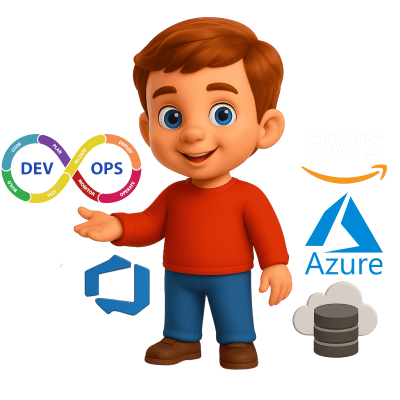
DevOps Course In Telugu : Master Multi-Cloud with AWS & Azure
Unlock Your DevOps Career. This course is your key to a high-paying job. Learn to build, automate, and scale applications on both Aws and Azure. You’ll finish with a portfolio of projects that get you hired.

100% Live
Training

2 Years
Recordings

Free
Addon Sessions

Real Time
Projects
Think High Salary Means More Coding? Think Again.
Most students think tech careers require hardcore programming. That’s no longer true. DevOps focuses on automation, cloud, deployment, and simple scripting, making it a great career path for freshers and non-IT graduates.
What Actually IS DevOps ?
DevOps is a modern software engineering philosophy that combines Development (Dev) and IT Operations (Ops). Traditionally, developers wrote code and operations teams deployed it manually—a slow, error-prone process. DevOps solves this by using CI/CD pipelines, Infrastructure as Code (IaC), and containerization to automate the entire software delivery lifecycle.
Why Multi-Cloud ? (AWS vs. Azure)
While AWS holds the highest global market share, Microsoft Azure is heavily dominating the enterprise and corporate sectors. By mastering both cloud platforms in this course, you don’t just learn a tool; you become an architecture expert capable of passing any technical interview, effectively doubling your career opportunities.
Why Learn Multi Cloud DevOps in 2026 ?
The demand for DevOps professionals is growing exponentially because businesses are adopting scalable cloud deployments and AI infrastructures.
Massive Industry Demand
Every app you use (Netflix, Uber, Swiggy) runs on Cloud DevOps. You are the engine keeping the tech world alive.
The "Low-Code" Advantage
We teach you Infrastructure as Code (IaC). You use powerful tools to automate servers instead of writing complex application logic.
Future-Proof against AI
AI needs massive cloud infrastructure and GPU clusters to run. DevOps engineers are the ones building and managing that exact infrastructure.
Unmatched Remote Opportunities
Because cloud infrastructure lives entirely on the internet, DevOps engineers have some of the highest remote work and international freelancing opportunities in the IT sector.
The Arsenal: Enterprise Tools You Will Master
We take you from absolute zero to deploying multi-cloud architectures using the exact tools Fortune 500 companies use.
Linux & Git Fundamentals
The absolute foundation of DevOps. Master command-line operations, file systems, and version control workflows.
AWS & Azure Cloud
Don't just learn one. Master the two biggest cloud giants on the planet. EC2, S3, Azure VMs, IAM, and heavy networking.
Docker & Kubernetes
The container revolution. Learn how to package, deploy, and auto-scale massive microservices applications flawlessly.
Terraform & Ansible
Master "Infrastructure as Code" (IaC). Provision hundreds of cloud servers in seconds with simple automation scripts.
Jenkins CI/CD
Build the pipelines that automate software delivery from the developer's laptop straight to production.
Prometheus & Grafana
Set up elite monitoring and observability systems to catch bugs and server crashes before the users even notice them.
The ROI of Cloud Mastery: DevOps Salaries in India
DevOps professionals are among the highest-paid IT workers in the world. Here is what the market is currently paying:
Fresher Devops Salaries
Job Role
Experience
Average Salary
DevOps Engineer
Fresher
₹5.0 – ₹8.0 LPA
AWS/Azure Cloud Engineer
Fresher
₹6.0 – ₹10.0 LPA
Kubernetes Administrator
Fresher
₹8.0 – ₹14.0 LPA
Site Reliability Engineer (SRE)
Fresher
Project-Based
Experience Devops Salaries
Job Role
Experience
Average Salary
DevOps Engineer
4+ Years Experience
₹18.0 – ₹35.0 LPA
AWS/Azure Cloud Engineer
5+ Years Experience
₹20.0 – ₹30.0 LPA
Kubernetes Administrator
6+ Years Experience
₹30.0 – ₹50.0 LPA
Site Reliability Engineer (SRE)
Experienced Consultant
₹1,00,000+ / Month
The Zero-to-Pro Learning Roadmap
Wondering how to start from scratch? Here is the exact learning path we take you on:
Phase 1 (The OS & Code)
Master Linux commands, shell scripting, and Git/GitHub version control.
Phase 2 (The Cloud)
Deep dive into AWS and Microsoft Azure architecture, networking, and security.
Phase 3 (Containerization)
Master the core rules of visual hierarchy, typography, color theory, and layout composition.
Phase 4 (Automation Pipelines)
Build seamless CI/CD delivery pipelines using Jenkins.
Phase 5 (Infrastructure as Code)
Use Terraform and Ansible to automate server creation without manual clicks.
Phase 6 (Observability & Portfolio)
Set up Prometheus monitoring and deploy your final enterprise projects to GitHub.
The Companies That Want to Hire You


What Makes This Course Different
👉 Module Wise Quizzes, Assignments, and Practice Questions
👉 100% Placement assistance
👉 Industry professionals with 10+ years of experience
👉 Live Chat support assistance
👉 Access to session recordings for 2 years
👉 EMI Option also available with specified cards
👉 Get ₹10,000 Worth of Free Career Booster Add-On Sessions
👉 Dedicated Job Updates
👉 100% Live Training in Telugu
👉 Industry Ready Training
👉 Interview Questions & Study Materials
👉 Resume & Linked In Preparation
Your Learning Journey: What to Expect
1. DevOps Fundamentals
- What is DevOps
- Evolution from Traditional Software Development to DevOps
- Why Organizations Use DevOps
- Goals and Benefits of DevOps
- DevOps Life Cycle
- How Cloud Relates to DevOps
2. Cloud Computing Fundamentals
- What is Cloud Computing
- Evolution from Traditional Computing to Cloud
- Types of Cloud (Service & Deployment Models)
- Cloud Providers
- Market Value of Cloud
3. Linux Administration
- Hardware Information Commands
- System Information Commands
- File & Directory Commands
- File Viewing & Editing
- File Permissions & Ownership
- User & Group Management
- Process Management
- Service Management (Systemd)
- Networking Commands
- Package Management
- Archive & Compression
- Disk & Storage Management
- Log Management
- Text Processing
4. Git, GitHub & Bitbucket
- Introduction to Version Control System (VCS)
- Introduction to Git
- Git Architecture & Concepts
- Basic Git Commands
- Branching and Merging
- Working with Remote Repositories
- Conflict Resolution
- Git Tags and Releases
- Introduction to GitHub
- Introduction to Bitbucket
5. Jenkins & CI/CD
- Introduction to Jenkins
- Continuous Integration (CI)
- Continuous Delivery (CD)
- Jenkins Architecture
- Installation & Setup
- Jenkins Dashboard
- Jenkins Jobs
- Jenkins Pipeline
- Jenkinsfile
- Integrating Jenkins with Git
- Build Automation
- Jenkins Plugins
- Jenkins Security
- Monitoring & Troubleshooting
6. Docker
- Docker Architecture
- Containers
- Images
- Dockerfile
- Storage
- Networks
- Docker Compose
- Docker Swarm
- Docker Stack
- Docker Integration with Jenkins
7. Kubernetes Fundamentals
- Introduction to Kubernetes
- Kubernetes Architecture
- Kubernetes Objects
- Kubectl Commands
- YAML
- Pods
- Labels & Selectors
- Services
- ReplicaSets
- Deployments
- HPA
- StatefulSets
- DaemonSets
8. Advanced Kubernetes
- ConfigMaps
- Secrets
- Storage (PV & PVC)
- Namespaces
- Ingress
- RBAC
- Resource Quotas
- Helm
- GitOps (ArgoCD)
- Network Policies
- Affinity
- Node Selector
- Taints & Tolerations
- Deployment Strategies
- Probes
- Jobs & CronJobs
- Observability Stack
- Backup & Disaster Recovery
- Cluster Upgrades
- Troubleshooting
9. Terraform
- Infrastructure as Code
- Terraform Architecture
- Providers & Resources
- Variables
- Outputs
- State Files
- Remote State
- Lifecycle
- Modules
- Workspaces
- Data Sources
- Provisioners
- Dependency Management
10. Advanced Terraform
- Terraform with AWS
- Terraform + Jenkins
- State Management
- Security
- Drift Detection
- Import Existing Infrastructure
11. Amazon Web Services (AWS)
- EC2
- VPC
- S3
- EBS
- IAM
- RDS
- ELB
- ASG
- ECR
- ECS
- EKS
- SNS
- CloudWatch
- Route 53
12. Microsoft Azure Services
- Azure Active Directory
- Virtual Machines
- VM Scale Set
- Azure Load Balancers
- Azure Container Registry
- Azure Container Instance
- Azure Kubernetes Service
- Azure Pipelines
- Azure SQL Database
- Azure Blob Storage
- Azure Disks
- Azure Artifacts
- Azure Key Vault
13. DevSecOps & Security Tools
- SonarQube
- OWASP
- Trivy
- Istio
- HCP
- TFSEC
14. MCP with DevOps
- Jenkins with MCP
- Docker with MCP
- Kubernetes with MCP
- Terraform with MCP
15. Self-Paced Learning
- Jenkins with MCP
- Docker with MCP
- Kubernetes with MCP
- Terraform with MCP
16. DevOps Best Practices & Real-World Implementation
- CI/CD Workflow
- Containerization
- Orchestration
- Infrastructure Automation
- Cloud Deployment
- Monitoring
- Security
- End-to-End DevOps Practices
Real - Time DevOps Projects Built on AWS & Azure Multi-Cloud
We don’t just teach theory. You will build a production-grade GitHub portfolio to prove your skills to recruiters.
1. Automation Deployment Using Jenkins Free Style and Pipeline Jobs
Automate code build, testing, artifact management, code quality analysis, and deployment using Jenkins CI/CD pipelines.
Tools Used : Git • GitHub • Jenkins • Maven • Nexus • SonarQube • Tomcat
2. Microservices Project
Build, scan, containerize, and deploy a microservices application using Docker with automated Jenkins pipelines.
Tools Used : Git • GitHub • Jenkins • Docker • SonarQube • Trivy • OWASP
3. Tier Application Using Docker Compose
Deploy a Java-based three-tier application with Docker Compose and automate deployments using Jenkins.
Tools Used : Git • Maven • Jenkins • Docker • Docker Compose • Tomcat • Datadog
4. Deploy 3 Tier Application Using AWS Cloud With High Availability
Deploy a Node.js application on AWS with high availability using VPC, Load Balancer, Auto Scaling, and Database.
Tools Used : AWS EC2 • VPC • Database • Load Balancer • Auto Scaling Groups
5. Deploy Blood Bank Application Using Kubernetes Kops Cluster
Deploy a three-tier Blood Bank application on Kubernetes KOPS with monitoring and high availability.
Tools Used : EC2 • IAM • S3 • AWS CLI • KOPS • Kubectl • Prometheus • Grafana
6. Deploy Online Library Application Using Kubernetes Kops Cluster
Deploy an Online Library application on Kubernetes KOPS with monitoring, scalability, and high availability.
Tools Used : EC2 • IAM • S3 • AWS CLI • KOPS • Kubectl • Prometheus • Grafana
7. Deploy an E-Commerce Application on EKS Cluster
Deploy an E-Commerce application on Amazon EKS with Jenkins automation and Kubernetes orchestration.
Tools Used : EC2 • IAM • S3 • AWS CLI • Amazon EKS • Kubectl • Prometheus • Grafana • Jenkins
8. Deploy a Python Based Application Using Argo CD
Deploy a Python application using GitOps with Argo CD on Kubernetes for automated and reliable delivery.
Tools Used : EC2 • IAM • AWS CLI • KOPS • Kubectl • Helm • Argo CD
9. Deploy a Full Stack Application From Local to Prod
Deploy a full-stack React and MongoDB application from local development to production using DevOps tools.
Tools Used : Docker • Kubernetes • Terraform • Argo CD • Jenkins • Slack • MongoDB • Amazon EKS
10. Deploy a Node Application Using Azure Cloud
Automate the deployment of a Node.js application on Azure Kubernetes Service using Azure DevOps pipelines.
Tools Used : Azure VM • VMSS • Azure CLI • AKS • Azure Pipelines • Docker • ACR
Watch the Demo of Our DevOps with Multi Cloud( AWS+AZURE ) Course in Telugu to Get a Preview of the Topics Covered.
From Their Desks to Your Screen
Hear from Our Students
Multi Cloud DevOps Mastery Session in Telugu
Actual Price
Rs. 79,999/-
Special Price
Rs. 15,999/-
Save
Rs. 64,000/-
- Time : 8:30 PM - 9:30 PM , 4+ Months Duration
- Start Date: 6th / Aug / 2026
- Beginner friendly
- Hands-on-Projects
- Telugu Explanation
- Live Support
Beyond Courses - We Build Careers.
Every program includes industry-focused add-on sessions designed to help students crack jobs, freelance, switch careers, and grow professionally.
- MAANG Ready
Career Acceleration Ecosystem
Everything you need beyond coding to become job-ready.
Resume Building
Session 01
LinkedIn Optimization
Session 02
Freelancing
Session 03
Career Switch Guidance
Session 04
Job Search Strategy
Session 05
Financial Awareness
Session 06
MAANG Preparation
Session 07
Agile & Scrum Workflow
Session 08
Git & GitHub
Session 09
HR + Salary Negotiation
Session 10
Communication Bootcamp
Session 11
Career Advancement Results
At Frontlines Edutech, we believe in transforming careers through high-quality, industry-relevant education. Our focus is on providing practical skills and knowledge that lead to real-world success. With a proven track record of impactful learning, we ensure our students are well-equipped to excel in their chosen fields and achieve their career goals with confidence.
Frequently Asked Questions
Q: Do I need prior coding experience or a Computer Science degree to join this course?
A: No! DevOps is largely a “Low-Code” IT field. Instead of writing heavy application code (like Java or C++), you will write simple scripts (YAML, Bash) to automate infrastructure. Whether you are a fresher or a non-IT student (B.Com/B.Sc), as long as you have dedication, we will teach you from absolute zero.
Q: I am currently a Manual Tester. Is DevOps a good career switch for me?
A: Yes, it is one of the best upgrades you can make. Moving from manual testing to DevOps and Cloud Automation will instantly multiply your market value and salary potential. You already understand the software lifecycle; now we teach you to automate its deployment.
Q: Are the live training classes conducted in Telugu?
A: Yes! All live sessions, cloud deployments, and doubt-clearing classes are taught in Telugu. We break down complex Kubernetes architectures and AWS networking concepts in your regional language to ensure absolute conceptual clarity.
Q: Why Multi-Cloud? Isn't learning just AWS enough?
A: While AWS is the market leader, massive enterprises heavily rely on Microsoft Azure. By mastering both AWS and Azure in this course, you bypass the competition and double the number of job roles you can apply for.
Q: Will AI tools replace DevOps Engineers?
A: Absolutely not. AI requires massive, secure, and highly scalable cloud infrastructure to function. DevOps engineers are the ones who build and manage the Kubernetes clusters and cloud servers that AI models run on. DevOps is entirely future-proof.
Q: Will I actually deploy real servers, or is this just theory?
A: This course is 100% practical. You will create your own AWS and Azure accounts and deploy real-time enterprise projects—including E-Commerce CI/CD pipelines and Dockerized applications—building a powerful GitHub portfolio to show recruiters.
Q: What is the starting salary for a DevOps Engineer in India?
A: Because DevOps engineers control the production infrastructure of a company, they command premium salaries. Freshers can expect starting salaries between ₹4 LPA and ₹7 LPA. With a few years of experience and Kubernetes mastery, salaries rapidly scale to ₹15 LPA to ₹30 LPA+.

Q: Can DevOps Engineers work remotely or as freelancers?
A: Yes. Cloud infrastructure exists entirely on the internet. You can easily take on highly lucrative freelance projects—such as migrating a startup’s servers to AWS or setting up a Jenkins pipeline—for international clients right from your laptop.
Q: Do you provide placement assistance?
A: Yes. We provide comprehensive placement support. This includes aggressive GitHub portfolio reviews, building an ATS-friendly DevOps Engineer resume, conducting live technical mock interviews, and providing direct job updates.
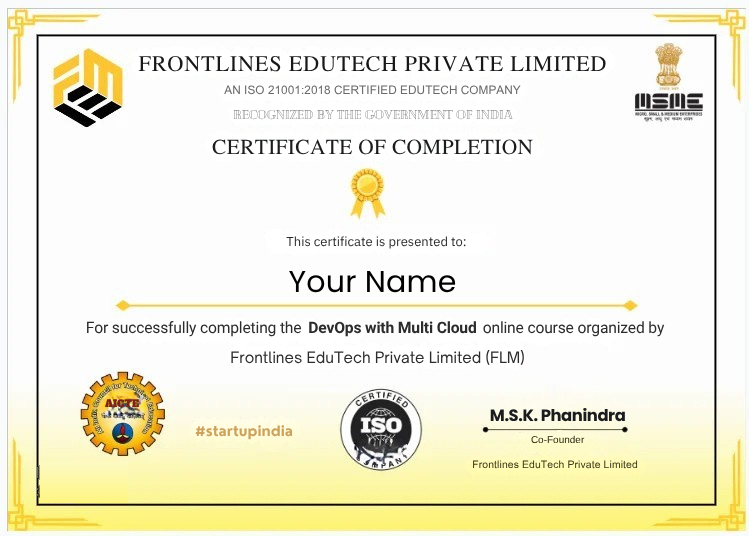
Q: Will I receive a certificate after completing the Multi Cloud DevOps course?
A: Yes. Upon successfully completing the training and deploying your real-time cloud projects, you will receive an industry-recognized certificate from Frontlines EduTech to boost your LinkedIn profile and resume credibility.
Get Certified
Yes, you’ll get a Certificate representing your Industry Readiness once you submit your projects and clear the pre placement test.

Approved by AICTE

Certified by ISO 21001:2018

Recognized by Startup India

Registered under MSME