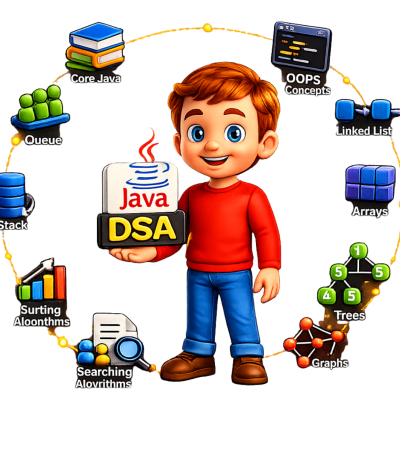
Master JAVA DSA Course problem solving, and from basics to advanced interview topics through live classes, structured practice, and real coding guidance. The brochure covers Java fundamentals, OOP, collections, arrays, strings, linked lists, stacks, queues, trees, graphs, heaps, greedy algorithms, and dynamic programming.

Training

Recordings

Addon Sessions

Projects
JAVA DSA is one of the strongest career foundations for students who want to crack software development interviews. This course helps learners build programming confidence first, then gradually move into real DSA problem-solving patterns used in coding rounds and technical interviews.
Java gives you the programming foundation to write structured, scalable, object-oriented code, while Data Structures and Algorithms help you solve problems efficiently. Together, they form the core skill set tested in software developer interviews across service-based and product-based companies.
If you want to become a strong programmer, DSA is not optional. This course is designed to take learners from Java basics like variables, loops, arrays, methods, and strings into advanced DSA areas such as binary search, recursion, linked lists, trees, graphs, heaps, greedy algorithms, and dynamic programming.
Companies do not just hire based on language knowledge they test how well you solve problems. This makes Java DSA one of the most important skills for freshers who want to become software developers.
Most coding interviews test arrays, strings, linked lists, trees, recursion, graphs, and dynamic programming. This course is built around exactly those patterns.
You start from program structure, conditionals, loops, arrays, methods, and strings before moving into advanced problem-solving. That makes the learning path structured instead of overwhelming.
This course is suitable for learners who want to prepare for placements, entry-level developer jobs, internships, and coding assessments. The syllabus starts from fundamentals and progressively builds depth
Instead of learning from scattered videos, you get a complete roadmap that includes Java basics, collections, sorting, linked lists, stacks, queues, trees, BST, heaps, graphs, bit manipulation, greedy, and dynamic programming.
This course goes far beyond syntax. It trains you in the exact concepts and problem-solving frameworks required to write better code and perform well in coding interviews.
Program structure, variables, data types, operators, input handling, conditionals, loops, methods, arrays, strings, and exception handling.
Classes, objects, constructors, this, wrapper classes, generics, ArrayList, HashMap, HashSet, Deque, and PriorityQueue.
Two pointers, sliding window, prefix sum, hashing, binary search, recursion, and backtracking.
Bubble sort, selection sort, insertion sort, merge sort, quick sort, counting sort, binary search foundations, and advanced binary-search problems.
Singly linked list, doubly linked list, fast and slow pointers, monotonic stack, queue, circular queue, and deque-based problems.
Binary trees, BST, heaps, greedy algorithms, bit manipulation, BFS, DFS, topological sort, DSU, Dijkstra’s algorithm, and dynamic programming.
Job Role
Experience
Average Salary
Java Developer
Fresher
₹3.5 – ₹7 LPA
Software Developer
Fresher
₹3 – ₹6 LPA
Backend Developer Trainee
Fresher
₹3.5 – ₹7 LPA
DSA – Associate
Fresher
₹2.5 – ₹6 LPA
Software Engineer
Fresher
₹5 – ₹7 LPA
Job Role
Experience
Average Salary
Product Engineer
3–5 Years
₹9 – ₹15 LPA
Software Development Engineer
3–5 Years
₹10 – ₹18 LPA
Software Engineer Intern
4–6 Years
₹12 – ₹20 LPA
Application Developer
5–6 Years
₹12 – ₹24 LPA
Senior Java Developer
5–8 Years
₹12 – ₹25 LPA










👉 Module Wise Quizzes, Assignments, and Practice Questions
👉 100% Placement assistance
👉 Industry professionals with 10+ years of experience
👉 Live Chat support assistance
👉 Access to session recordings for 2 years
👉 EMI Option also available with specified cards
👉 Get ₹10,000 Worth of Free Career Booster Add-On Sessions
👉 Dedicated Job Updates
👉 100% Live Training in Telugu
👉 Industry Ready Training
👉 Interview Questions & Study Materials
👉 Resume & Linked In Preparation
Dynamic Programming
Trie
Course Revision
Mock Interviews
Master Java DSA through 65 hands-on coding assignments, live coding problems, and interview-focused exercises designed to strengthen problem-solving, coding logic, and algorithmic thinking.
Programming Fundamentals
Variables, loops, conditionals, functions, pattern printing, number theory, arrays, matrices, and complexity analysis.
Core DSA
Arrays, Strings, Hashing, Binary Search, Sliding Window, Prefix Sum, Recursion, Backtracking, Sorting, Linked Lists.
Advanced DSA
Stacks, Queues, Trees, BST, Heap, Greedy Algorithms, Bit Manipulation, Graphs, Dynamic Programming, Trie.
Interview Preparation
Practice classes, timed coding assignments, full course revision, mock interviews, and final interview preparation.
Rs. 34,999/-
Rs. 17,999/-
Rs. 17,000/-
Every program includes industry-focused add-on sessions designed to help students crack jobs, freelance, switch careers, and grow professionally.
Everything you need beyond coding to become job-ready.
Session 01
Session 02
Session 03
Session 04
Session 05
Session 06
Session 07
Session 08
Session 09
Session 10
Session 11
At Frontlines Edutech, we believe in transforming careers. Our JAVA DSA Course is laser-focused on providing the practical, AI-driven skills and knowledge that lead directly to real-world job success, ensuring you are well-equipped to achieve your career goals with confidence.
Yes. The course starts from the very basics such as Java program structure, variables, data types, conditionals, loops, arrays, methods, and strings before moving into advanced DSA topics. This makes it suitable for beginners, students, and learners who want a structured coding foundation.
No prior coding knowledge is required. The initial Java foundation track is designed to help learners understand core programming concepts clearly before entering interview-level data structures and algorithms.
DSA is one of the most important parts of coding interviews because it tests how efficiently you solve problems. Topics like arrays, strings, binary search, linked lists, stacks, queues, trees, graphs, and dynamic programming are commonly asked in technical rounds.
Yes. The brochure clearly includes a Java basics track followed by an extensive DSA roadmap covering arrays, sliding window, hashing, binary search, recursion, sorting, linked lists, stacks, queues, trees, BST, heaps, graphs, greedy algorithms, bit manipulation, and dynamic programming.
Yes. This course is highly relevant for placement preparation because it focuses on programming fundamentals, coding logic, timed practice, revision modules, and interview-style DSA concepts. It is especially useful for students targeting entry-level software development roles.
Yes. The syllabus includes classes, objects, constructors, this, wrapper classes, generics, ArrayList, HashMap, HashSet, Deque, and PriorityQueue, which help learners build practical understanding of core Java and object-oriented concepts.
Yes. The DSA roadmap specifically includes arrays, two pointers, sliding window, prefix sum, hashing, and binary search, which are some of the most common problem-solving patterns used in coding interviews.
Yes. The advanced part of the syllabus includes graph representation, BFS, DFS, topological sort, union find, Dijkstra’s shortest path, and multiple dynamic programming modules including 1D DP, 0/1 knapsack, LIS, grid DP, and DP on strings.
Yes. The course is designed with Telugu explanation support so learners can understand the concepts comfortably, while also becoming familiar with technical terminology used in interviews and development environments.
Yes. This page should position the course with resume guidance, coding interview preparation, placement updates, and mock-support style add-ons, matching the overall Frontlines landing-page model used in other courses.
You will practice problems across Java basics, arrays, strings, hashing, binary search, recursion, linked lists, stacks, queues, trees, heaps, graphs, greedy algorithms, and dynamic programming. The brochure includes multiple practice modules and revision-based timed practice sections as well.
After completing the course, learners can target roles such as Java Developer, Junior Software Developer, Backend Developer Trainee, Software Engineer Fresher, and other entry-level development roles where Java programming and DSA problem-solving are important.
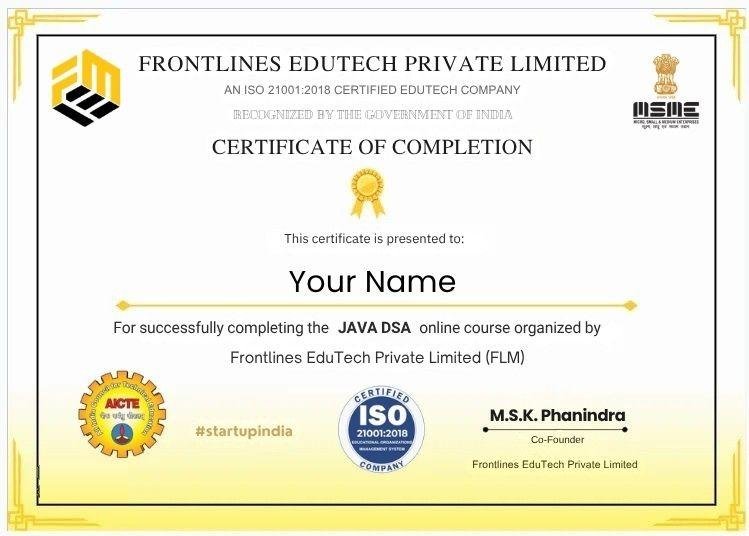
Yes, you’ll get a Certificate representing your Industry Readiness once you submit your projects and clear the pre placement test.