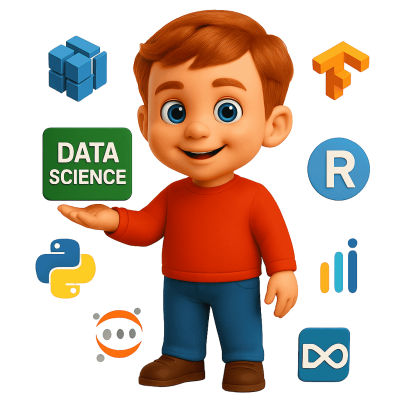
Data Science is the process of collecting, analyzing, and interpreting massive amounts of data to solve complex business problems. A Data Scientist uses programming and algorithms to predict what will happen next whether that is predicting a stock market crash, diagnosing a disease, or recommending a movie on Netflix.
The Evolution: Machine Learning, Deep Learning & NLP
We don’t just teach basic data analysis; we train you in advanced Artificial Intelligence.
Machine Learning (ML)
Training algorithms to learn patterns from historical data and make autonomous predictions (like fraud detection in banking).
Deep Learning (DL)
Building complex Neural Networks inspired by the human brain to process images, voice, and ultra-complex data.
Natural Language Processing
Teaching computers to understand, interpret, and generate human language (the exact technology behind ChatGPT and virtual assistants).
Generative AI & LLMs
Learn how AI models generate content, answer questions, and work with data using technologies behind ChatGPT, Gemini, and Claude.
Modern QA is moving beyond manual testing. Companies now need testers who can validate UI, APIs, databases, automation workflows and use AI-powered tools to deliver faster, smarter and more reliable software.
Unprecedented Industry Demand
Startups, global banks, ecommerce giants, and healthcare networks are in a desperate bidding war for professionals who can build AI-powered systems.
Future-Proof Your Career:
Traditional coding jobs are being automated, but Data Scientists are the ones building the automation. This is the safest, most future-proof career in tech.
Massive Salary Opportunities
Because AI directly drives revenue and efficiency, specialized roles like Machine Learning Engineer and AI Engineer command the highest paychecks in the industry.
Global Remote Opportunities
AI infrastructure lives in the cloud. You can build, train, and deploy predictive models for international clients entirely remotely.
Tools & Technologies You Will Learn in Data Science Course
We train you on the exact tools required by top product-based companies and global IT service giants:
Python Programming
The undisputed language of AI. We start from absolute zero, teaching you how to use Python, Pandas, and NumPy to process and manipulate massive datasets effortlessly.
SQL & Data Analytics
Learn to query corporate databases to extract the exact data you need before feeding it into your AI models.
Machine Learning (Scikit-Learn)
Master supervised and unsupervised learning. Build regression and classification models to predict pricing, customer churn, and business trends.
Deep Learning (TensorFlow & Keras)
Step into advanced AI. Build powerful Neural Networks that can recognize images, predict complex sequences, and automate heavy enterprise tasks
Natural Language Processing (NLP)
Master the technology behind modern chatbots. Learn text processing, sentiment analysis, and how to build AI systems that understand human language.
Model Deployment
Deploy machine learning models into real applications and learn the basics of APIs, model monitoring, and production-ready AI workflows.
Your Roadmap to Master Data Science Course
1. PYTHON INTRODUCTION & ENVIRONMENT SETUP
Introduction, Roadmap
Program Execution – programmer’s view, Python’s view
Build an AI model to predict obesity risk based on lifestyle and health-related survey data. Compare multiple machine learning algorithms and identify the model that gives the best prediction accuracy.
Tools Used:
Python · Pandas · NumPy · Scikit-learn · Random Forest · SVM · ANN · KNN
01
Financial Risk Prediction for Loan Approval
Analyze customer financial data to predict loan approval chances and estimate financial risk. Use classification and regression models to understand borrower profiles and support smarter lending decisions.
Analyze university and country datasets to identify education trends, rankings, and geographical patterns. Work with structured CSV data and extract useful insights through data analysis.
Tools Used:
Python · Pandas · CSV Handling · Data Analysis
01
Online Shopping System
Build a Python-based shopping cart system using OOP concepts. Implement product selection, GST calculation, invoice generation, order summary, and basic transaction workflows.
Tools Used:
Python · OOP Concepts · Functions · File Handling
02
Analytic American Association
Develop a law firm management system to manage clients, lawyers, billing, invoices, and daily operations. Apply Python OOP and file handling to automate common administrative workflows.
Tools Used:
Python · OOP Concepts · File Handling · Data Management
03
Sales Data Insights
Analyze sales datasets to understand revenue trends, customer behavior, product performance, and business patterns. Use data libraries and visualizations to convert raw sales data into useful insights.
Tools Used:
Python · Pandas · NumPy · Data Visualization
04
Why This Data Science Course Is Your Best Bet
👉 Module Wise Quizzes, Assignments, and Practice Questions
👉 100% Placement assistance
👉 Industry professionals with 10+ years of experience
👉 Live Chat support assistance
👉 Access to session recordings
👉 EMI Option also available with specified cards
👉 Get ₹10,000 Worth of Free Career Booster Add-On Sessions
👉 Dedicated Job Updates
👉 100% Live Training in Telugu
👉 Industry Ready Training
👉 Interview Questions & Study Materials
👉 Resume & Linked In Preparation
Career & Job Readiness Support
Every program includes industry-focused add-on sessions designed to help students crack jobs, freelance, switch careers, and grow professionally.
MAANG Ready
Career Acceleration Ecosystem
Everything you need beyond coding to become job-ready.
First thing I like was they always bring us trending technologies that can scale our career significantly.
They always strive to bring best to their
students. (I got 2 best trainers from the market).
And I would like to share my experience after being a learner of flm
This is for the students, to the students and by the professionals
Naresh JuttigaData Science Student
I enrolled data science course in 2024.chaitanya sir explanation is to good I am beginner that time I don't have any idea about ml and dl now lam doing some projects, sir valuable teaching and job related tips helps to boost my confidence.
Voleti venkata sairamData Science student
It's good that we learn so much from FLM.
We gain a lot of knowledge from FLM, which is great.
It's great that we're learning so much through FLM.
FLM helps us gain a lot of knowledge.
We benefit a lot from FLM in terms of knowledge.
ParthaSarathiData science Student
I recently completed the Data Science course at FLM and it was an excellent learning experience! The course was well-structured, covering all the essential topics like Python programming, data analysis, machine learning.
bandaru bapirajuData science Student
The FLM is excellent. Not only do they teach software subjects clearly and affordably, but their soft skills, aptitude, and reasoning classes are also handled very well by experienced trainers.
Bellana RamojiData Science Student
I recently completed Data science Course in FLM.The way of teaching is good and understandable for beginner
also. Thank you FLM.
PRASADAM GURU PRASADData Science Student
very detailed video lecturers. help full doubt sessions.Real time projects with full handson experince and u will get every day job notification through whatsapp.
Prasanth VadapalliData Science Student
I have taken Data science course from FLM their explanation was too good they were explaining like beginner friendly everyone able to understand concepts easily like non-coding experience background people also understand very well and they will provide you add on sessions like interview preparation, Resume building and many more. Thanks to FLM.
KUNDLA RAMCHARANData Science Student
Felt really good with the amount of efforts that frontlines media putting to give best teaching methodologies
They are delivering this with high quality and reasonable prices
Hope they will continue to do this again and again
CH SWAROOP REDDYData Science Student
recently completed a Data science course, and it was a great learning experience. The content was well- structured, and the trainers explained the concepts clearly with practical examples. The trainers explained the concepts clearly with real-time examples. The hands-on projects really helped me build confidence.
Career Paths After Learning Data Science Course
Job Role
Experience
Average Salary
Fresher Salaries
Data Analyst
Fresher
₹4 – ₹8 LPA
Data Scientist
Fresher
₹6 – ₹12 LPA
ML Engineer
Fresher
₹4 – ₹12 LPA
AI Engineer / Architect
Fresher
₹3 – ₹4 LPA
Deep Learning Specialist
Fresher
₹5 – ₹8 LPA
Job Role
Experience
Average Salary
Experienced Salaries
Data Analyst
3–5 Years
₹12 – ₹18 LPA
Data Scientist
5–8 Years
₹20 – ₹40 LPA
ML Engineer
4–6 Years
₹15 – ₹30 LPA
AI Engineer / Architect
5–8 Years
₹12 – ₹25 LPA
Deep Learning Specialist
4–6 Years
₹15 – ₹28 LPA
Companies That Want to Hire You
Our Results Speak for Themselves
At Frontlines Edutech, we don’t just teach we transform careers. Our Data Science Course is designed to give you the practical skills and confidence needed to not only land a job but also excel in your chosen field.
Happy Students
0k+
Batches Conducted
0+
Years of Experience
0+
Satisfaction
0%
Frequently Asked Questions
1. Do I need a strong background in Mathematics or heavy coding knowledge to learn AI?
No! While Data Science involves math, modern Python libraries and LLM frameworks (like LangChain and TensorFlow) do the complex mathematical calculations for you. We teach you the logic behind the systems and how to apply them. You do not need a Ph.D. to become a highly paid AI Engineer.
2. I am from a non-IT background (B.Com, BBA, B.Sc). Is this a good career path for me?
Absolutely. In fact, English and logical thinking are the new programming languages. Prompt Engineering and AI Automation are the fastest ways for non-IT students to bypass traditional coding roles and secure high-paying tech salaries. We teach you Python from absolute zero.
3. Are the live training classes conducted in Telugu?
Yes! All sessions, practical model training, and doubt-clearing classes are taught in Telugu. We break down complex Machine Learning algorithms and GenAI frameworks in your regional language to ensure absolute conceptual clarity.
4. What is the difference between Data Analytics and Data Science?
A Data Analyst looks at past data to explain what happened (using tools like SQL and Power BI). A Data Scientist builds AI and Machine Learning models to predict what will happen in the future. This course takes you to the advanced, predictive level.
5. What are Machine Learning and Deep Learning?
Machine Learning is training a computer to recognize patterns in data so it can make decisions without being explicitly programmed. Deep Learning is an advanced form of ML that uses “Neural Networks” (inspired by the human brain) to handle ultra-complex tasks like image recognition and ChatGPT-style language processing.
6. Will I actually build real AI models, or is this just theory?
This course is entirely project-driven. You will process real-world datasets and build live AI models—including RAG Document Assistants, Loan Risk Predictors, and Custom AI Chatbots—to showcase directly to hiring managers on your GitHub.
7. What is the starting salary for a Data Scientist or ML Engineer in India?
Because AI directly drives massive corporate revenue, professionals are paid a premium. Freshers can expect starting salaries between ₹6 LPA and ₹12 LPA. With Deep Learning expertise and experience, salaries rapidly scale to ₹25 LPA to ₹50 LPA+.
8. Can I work internationally or remotely after learning Data Science?
Yes. AI and Data Science are universally demanded skills. Companies worldwide are desperate for talent. You can work remotely, take on lucrative international consulting contracts, or participate in global predictive modeling competitions like Kaggle.
9. Do you provide placement assistance?
Yes. We provide comprehensive placement support. This includes aggressive GitHub portfolio reviews, building an ATS-friendly AI professional resume, conducting live technical mock interviews, and providing direct job updates for top tech companies.
10. Will I receive a certificate after completing the course?
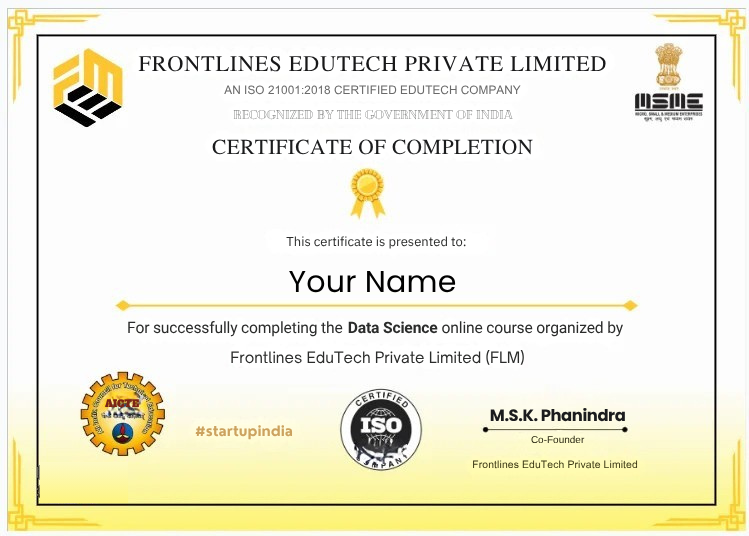
Yes. Upon successfully completing the training and deploying your real-time AI and Machine Learning projects, you will receive an industry-recognized certificate from Frontlines EduTech to massively boost your LinkedIn profile and resume credibility.
Get Certified
Yes, you’ll get a Certificate representing your Industry Readiness once you submit your projects and clear the pre placement test.