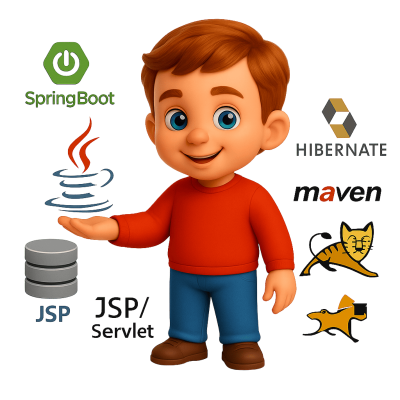
Advanced Java with Spring Boot & Microservices – Build Scalable Enterprise Applications
Learn Advanced Java, Hibernate, Spring Framework, Spring Boot, Spring AI, and Microservices to design and deploy modern enterprise-grade applications. Beginner-friendly training in Telugu.
What is Advanced Java with Spring Boot & Microservices?
Java is the indestructible backbone of the internet. While other programming languages come and go, Java remains the undisputed king of enterprise software. The world’s biggest platforms including banking systems, massive e-commerce sites, and telecom networks rely on Java for its unmatched security and scalability.
But modern companies don’t just want basic Java developers; they want Cloud-Native Backend Engineers.
Spring Boot Framework
Learn how to build fast, secure, production-ready backend applications using Spring Boot. Understand dependency injection, configuration, annotations, controllers, services, and real-world application structure.
Microservices Architecture
Learn how large applications are divided into smaller, independent services that can scale and work together. Understand service communication, API-based architecture, scalability, and fault-tolerant systems.
REST APIs & Database Integration
Learn how backend applications connect with users, apps, and databases through REST APIs. Work with CRUD operations, JSON, Spring Data JPA, Hibernate, SQL, and database-driven application development.
Learn in Telugu
Complex Java, Spring Boot, APIs, databases, and Microservices concepts are explained in easy Telugu. This helps freshers, career switchers, and working professionals understand enterprise backend development more confidently.
Modern companies need backend developers who can build secure, scalable, cloud-ready applications. Learning Advanced Java with Spring Boot and Microservices can help you move beyond basic coding and develop the skills used in real enterprise software projects.Modern QA is moving beyond manual testing. Companies now need testers who can validate UI, APIs, databases, automation workflows and use AI-powered tools to deliver faster, smarter and more reliable software.
Enterprise Java Is Still in Strong Demand
Banks, fintech companies, e-commerce platforms, telecom, healthcare, and large enterprises continue to use Java for critical applications. Strong Java backend skills can open opportunities across many industries.
Microservices Power Modern Applications
Large applications are moving from traditional monolithic systems to smaller, independent Microservices. Learning this architecture helps you understand how scalable applications are built and maintained.
Spring Boot Makes Backend Development Faster
Spring Boot simplifies enterprise Java development and reduces repetitive configuration. You can build REST APIs, backend services, database applications, and production-ready systems more efficiently.
Backend Skills Support Cloud & AI Applications
AI and cloud applications still need secure APIs, databases, authentication, and backend business logic. Java developers who understand Spring Boot and Microservices can work on the systems that power these modern applications.
Tools & Technologies You Will Master
Learn the complete backend technology stack used to build secure, scalable, enterprise-level Java applications.
Core & Advanced Java
Build a strong Java foundation with OOP, Collections, Exception Handling, Multithreading, JDBC, and advanced programming concepts used in real backend applications.
Spring Boot & Hibernate
Learn to build production-ready backend applications using Spring Boot. Work with Hibernate and JPA to connect, manage, and interact with databases efficiently.
REST APIs & Spring Security
Build secure REST APIs and understand authentication, authorization, JWT tokens, role-based access, and Spring Security for modern backend applications.
Microservices & API Gateway
Learn how to break large applications into independent Microservices. Work with service communication, Eureka Server, API Gateway, and scalable distributed architecture.
Kafka & Event-Driven Architecture
Understand real-time communication between services using Apache Kafka. Learn producers, consumers, event streaming, and how modern applications process data asynchronously.
Cloud Deployment
Learn how to containerize Java applications with Docker, manage Microservices using Kubernetes, and understand the basics of deploying backend applications to cloud environments.
Advanced JAVA Complete Course Syllabus
1. Hibernate – Fundamentals
Introduction to Hibernate
What is ORM?
JDBC vs Hibernate
Hibernate Core Concepts
Configuring Hibernate Configuration XML File
Understanding Entity Classes
Id Annotation and Generation Methods
Cascade Types
2. Hibernate – CRUD & Relationships
Manipulating and Querying Persistent Data
Session Factory
Session
CRUD Operations
Transaction Management
One-to-One Mapping
One-to-Many Mapping
Many-to-One Mapping
Many-to-Many Mapping
Eager vs Lazy Loading
3. Advanced Hibernate
Hibernate Query Language (HQL)
Native Queries
Named Queries
4. Spring Framework – Core
Introduction to Spring
What is a Framework?
Advantages of Spring
Spring Modules Overview
Spring Core
What are Beans?
Spring Containers
Bean Lifecycle
Understanding IOC & DI
Bean Scope
Singleton Design Pattern
5. Spring Configuration & Dependency Injection
Spring Bean Configuration using XML
Java-based Spring Bean Configuration
Annotation-based Spring Bean Configuration
Types of Dependency Injection
6. Spring JDBC & Spring ORM
Configuring Data Source
Configuring JDBC Template
CRUD Operations using JDBC Template
Row Mapper
Advantages of Spring ORM over Hibernate
Configuring LocalSessionFactoryBean
Configuring HibernateTemplate
CRUD Operations using HibernateTemplate
7. Spring MVC
Understanding MVC Architecture
Dispatcher Servlet
Types of Controllers
Model and View
Internal View Resolver
Working with JSPs and HTML Pages
8. Spring Boot Fundamentals
Creating Spring Starter Projects
Understanding application.properties and application.yml Files
Spring Boot Starters
Annotations in Spring Boot
Introduction to Spring Boot
Features and Advantages of Spring Boot
Spring vs Spring Boot
Auto Configuration in Spring Boot
9. Spring Boot REST & Data JPA
Spring Boot Rest
Building Rest APIs
RestController vs Controller
Handling HTTP Methods
Handling Status Codes using ResponseEntity
Working with Thymeleaf
Spring Data JPA Overview
CRUD Operations with JPA Repository
Finder Methods in JPA
Java Persistence Query Language (JPQL)
Custom Queries
@Transactional Annotation
10. Spring AOP, Exception Handling & Actuator
Overview of Spring AOP
Join Points, Point Cuts, Advice, Aspects
Logging using AOP
Exception Handling
RestControllerAdvice and ControllerAdvice
Exception Handlers
Spring Boot Actuator
What is an Actuator?
Metrics using Actuator
Scheduling
What is scheduling
Advantages of scheduling
What are Cron jobs?
Enabling scheduling in spring boot with cron expressions.x
11. Redis Caching
Introduction to Caching
What is caching?
Why caching is needed (DB bottleneck problem)
Types of caching:
In-memory vs Distributed cache
Introduction to Redis
What is Redis? (In-memory data store)
Key features
High performance
Key-value store
Redis Setup
Installing Redis (local setup)
Running Redis server
Redis CLI basics
12. Redis with Spring Boot & Microservices
Spring Boot Integration with Redis
Adding Redis dependency
Configuration (application.yml)
Using RedisTemplate
Caching with Spring Boot
@Cacheable
@CachePut
@CacheEvict
TTL (Time To Live)
Expiration of cache
Setting TTL in Redis
Why TTL is important
Introduction to Microservices
Advantages & Challenges of Microservices
Monolithic vs Microservices Architecturex
13. Microservices Architecture
Service Discovery
What is Service Discovery?
Creating Eureka Server
Registering Services in Eureka
Inter-Service Communication
Synchronous vs Asynchronous Communication
Configuring Rest Template
Communicating using Rest Template
Configuring Feign Client
Communicating using Feign Client
Config Server
What is a Config Server?
Creating an In-Memory Config Server
Config Server with GitHub
14. API Gateway, Circuit Breaker & Kafka
API Gateway
What is a Gateway?
Setting Up an API Gateway
Routing Requests to Services
Circuit Breaker
Why Do We Need a Circuit Breaker?
Setting Up Resilience4j
Writing Fallback Methods
Setting Thresholds and Managing Circuit
Kafka
What is Asynchronous messaging?
Synchronous messaging vs Asynchronous messaging?
When Should I use Async Messaging?
What is a kafka broker?
Producer vs Consumer in kafka
What are partitions in kafka
What are topics in Kafka
What are offsets in kafka
What is a kafka template
Setting up a Spring Boot project with Kafka
Publishing a message into a kafka topic using Spring Boot
Consuming a message using Kafka Listeners
StringSerializer vs JSON
Using JSON Serialisation and Deserialisation in Kafka
Build a complete hospital management platform to handle doctors, patients, appointments, staff, beds, notifications, and patient records. Add AI-powered features such as diet recommendations and smart assistance to improve healthcare workflows.
Tools Used:
Java · Spring Boot · Spring Data JPA · Hibernate · REST APIs · MySQL · Spring Security · JWT · Microservices · Spring AI
01
StayEase – Accommodation Management System
Develop a backend system for PG and accommodation management where owners can manage properties, rooms, beds, rent, and availability while users can search and book suitable accommodation.
Tools Used:
Java · Spring Boot · Hibernate · Spring Data JPA · REST APIs · MySQL · Spring Security · JWT · Microservices
02
Smart Bank Management System
Create a secure online banking application where users can manage accounts, transfer funds, perform transactions, view balances, and apply for loans. Implement authentication, transaction handling, and secure banking workflows.
Tools Used:
Java · Spring Boot · Spring Security · JWT · REST APIs · Hibernate · MySQL · Microservices · Kafka
03
PFMS – Personal Finance Management System
Build a personal finance platform that helps users track income, expenses, transactions, spending patterns, and budgets. Add analytics to help users understand their financial habits and manage money better.
Tools Used:
Java · Spring Boot · Spring Data JPA · Hibernate · REST APIs · MySQL · Spring Security · JWT · Kafka · Microservices
Build a complaint management system where residents can raise, track, update, and monitor complaints related to maintenance and community services. Admins can assign issues, update status, and manage complaint resolution efficiently.
Tools Used:
Java · Spring Boot · Spring Data JPA · Hibernate · REST APIs · MySQL · Spring Security · JWT
01
AI-Based Resume Screening System using Spring AI
Develop an AI-powered recruitment system that compares resumes with job descriptions, scores candidates, supports shortlisting, and generates useful hiring insights for recruiters.
Tools Used:
Java · Spring Boot · Spring AI · REST APIs · MySQL · Spring Data JPA · LLM Integration · Prompt Engineering
02
Application Creation and Update Sets
Build a custom ServiceNow application, configure forms and layouts, and migrate changes across instances using Update Sets.
🛠 Tools Used: ServiceNow Studio • Forms • Update Sets • Tables
Onboarding Service Catalog
Create an employee onboarding catalog with service requests for laptops, mice, and other organizational resources
🛠 Tools Used: Incident Management • Forms • UI Policies • Business Rules
Incident Management
Configure the Incident Management lifecycle with forms, field conditions, and workflow customization
🛠 Tools Used: Incident Management • Forms • UI Policies • Business Rules
Change Management
Implement the Change Management lifecycle with customized forms and approval workflows.
Advanced Java, Spring Boot & Microservices training with deep concepts and practical exposure, helpful for interviews.
Ambadipudi Venkata HarikaAdvanced JAVA Student
Engaging Advanced Java, Spring Boot & Microservices training with clear concepts and practical project applications.
Jayanth Reddy PongaAdvanced JAVA Student
Great Advanced Java upskilling course. Fayaz Sir explains with simple analogies, making learning easy for everyone.
OumprakashAdvanced JAVA Student
Excellent Java Backend course with practical projects, real-world examples, mock interviews, and career guidance.
sharmila mettaAdvanced JAVA Student
Well-structured JFS course with practical learning. The trainer explains complex concepts clearly and patiently.
Bala Gowtham YadavAdvanced JAVA Student
Well-structured JFS course with practical learning. The trainer explains complex concepts clearly and patiently.
grace angelAdvanced JAVA Student
Great Advanced Java and Spring Boot training with simplified backend concepts and hands-on coding practice.
Venkata Pavan BoligorlaAdvanced JAVA Student
Great platform for Java, Spring Boot and Microservices learning, with excellent teaching and student guidance.
Mora Vennela Leela PadmavathiAdvanced JAVA Student
Fayaz Sir explains concepts clearly and simply. The affordable course helped me gain confidence in my skills.
Sai Jyotshna VysyarajuAdvanced JAVA Student
Excellent Advanced Java training. Fayaz Sir explains difficult concepts simply with real-time examples.
THARUN KUMAR REDDY DHANIPATIAdvanced JAVA Student
A valuable Advanced Java course with patient training, helpful support, Resume Building, LinkedIn, and career guidance.
Kachana Nanda Kishore ReddyAdvanced JAVA Student
Positive learning experience with a well-structured Advanced Java course and easy-to-understand practical training.
Jagadeesh BobbiliAdvanced JAVA Student
One of the best platforms to learn Advanced Java, DevOps, Java Full Stack, DSA, Data Analytics, and more.
Lakshmi TallapareddyAdvanced JAVA Student
A good platform for freshers and professionals to learn, build skills, and prepare for future job opportunities.
SriKanth naniAdvanced JAVA Student
FLM offers learning from basics to advanced levels. Fayaz Sir makes sessions engaging, knowledgeable, and enjoyable.
Vajjala venu gopal Advanced JAVA Student
Completed Advanced Java training with Fayaz Sir. Excellent teaching, clear explanations, and strong subject expertise.
shaik hussainAdvanced JAVA Student
Great Advanced Java learning experience with well-structured content and clear, practical coverage of key concepts.
Pasupula Sunil kumarAdvanced JAVA Student
FLM's engaging teaching helped me overcome my fear of Java, understand real-time concepts, and get placed at Accenture.
Ayesha BegumAdvanced JAVA Student
Happy and satisfied with the JFS course. Every concept was explained clearly with detailed real-life examples.
kumburu JagadeeshAdvanced JAVA Student
Approachable and trustworthy trainers provide genuine teaching focused on practical skills and real-time applications.
Career Paths After Learning Advanced JAVA Course
Job Role
Experience
Average Salary
Fresher Salaries
Java Developer
Fresher
₹4 – ₹8 LPA
API Developer
Fresher
₹5 – ₹9 LPA
Backend Developer
Fresher
₹5 – ₹10 LPA
Spring Boot Developer
Fresher
₹6 – ₹12 LPA
Job Role
Experience
Average Salary
Experienced Salaries
Senior Java Developer
3–5 Years
₹12 – ₹22 LPA
Backend Engineer
4–6 Years
₹15 – ₹28 LPA
Microservices Engineer
5–8 Years
₹20 – ₹35 LPA
Software Architect
8–12 Years
₹35 – ₹60 LPA
Companies Hiring Advanced Java Specialist Roles
Career Advancement Results
At Frontlines Edutech, we believe in transforming careers through high-quality, industry-relevant education. Our focus is on providing practical skills and knowledge that lead to real-world success. With a proven track record of impactful learning, we ensure our students are well-equipped to excel in their chosen fields and achieve their career goals with confidence.
Happy Students
0k+
Batches Conducted
0+
Years of Experience
0+
Satisfaction
0%
Frequently Asked Questions
1. Do I need prior coding experience or a basic understanding of coding and SQL to join this course?
Yes, you should have an average/basic understanding of coding concepts and SQL to join this course. We will provide recorded videos covering Core Java fundamentals and SQL basics to help you strengthen your foundation. After that, you will progress to Advanced Java, Spring Boot, and Microservices, with practical learning throughout the course.
2. Is Java still in demand, or is Python a better career choice in 2026?
While Python is great for Data Science, Java is the undisputed king of Enterprise Backend Systems. Over 90% of Fortune 500 companies (banks, e-commerce, telecom) rely on Java and Spring Boot for their core architecture because of its unmatched security and scalability. The hiring demand for Java Backend Engineers is massive.
3. Are the live training classes conducted in Telugu?
Yes! All live sessions, coding implementations, and doubt-clearing classes are taught in Telugu. We break down complex distributed systems, microservices architectures, and API logic in your regional language to ensure absolute conceptual clarity.
4. Why do I need to learn Microservices and Kafka? Isn't Spring Boot enough?
Basic Spring Boot gets you a basic job. To command top-tier salaries, you must know how to build massive, scalable apps like Uber or Netflix. Microservices and Kafka are the exact enterprise architectures those companies use to handle millions of users. Knowing them puts you in the top 5% of candidates.
5. Will AI tools like ChatGPT replace Backend Java Developers?
No! AI cannot run without a powerful backend infrastructure. AI needs secure APIs, databases, and servers to function. Furthermore, we teach you Spring AI, showing you exactly how to integrate these powerful Large Language Models (LLMs) directly into your Java backend systems, making you future-proof.
6. Will I actually build real APIs and Microservices, or is this just theory?
This course is entirely project-driven. You will build a professional GitHub portfolio containing live backend systems including Secure Banking APIs, E-Commerce Microservices, and Real-Time Notification Engines to show directly to hiring managers.
7. What is the starting salary for a Spring Boot / Microservices Developer in India?
Because Backend Engineers control the core logic and security of an application, they are paid a premium. Freshers can expect starting salaries between ₹5 LPA and ₹12 LPA. As you gain experience, Software Architects and Microservices Engineers routinely earn between ₹20 LPA and ₹40 LPA+.
8. Is Backend Development a good career for remote work or freelancing?
Absolutely. Almost every modern application (mobile or web) requires a backend REST API to function. You can easily take on highly lucrative freelance projects building and securing APIs for international clients right from your laptop.
9. Do you provide placement assistance?
Yes. We provide comprehensive placement support. This includes aggressive GitHub portfolio reviews, building an ATS-friendly Software Engineer resume, conducting live coding mock interviews, and providing direct job updates for top tech companies.
10. Will I receive a certificate after completing the Advanced Java course?
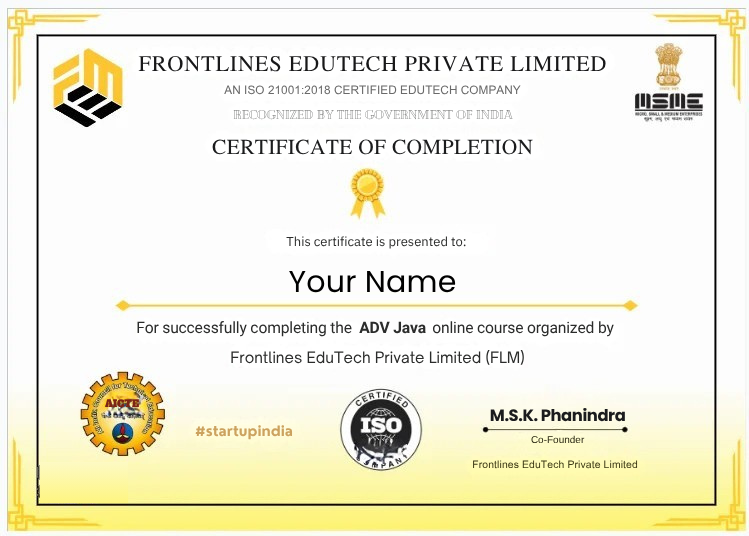
Yes. Upon successfully completing the training and deploying your real-time backend projects, you will receive an industry-recognized certificate from Frontlines EduTech to boost your LinkedIn profile and resume credibility.
Get Certified
Yes, you’ll get a Certificate representing your Industry Readiness once you submit your projects and clear the pre placement test.