AI Mastery Course in Telugu From Python to Agentic AI Scratch to Industry-Ready AI Professional
Build your AI skills from Python fundamentals to advanced AI applications with FLM’s AI Mastery Course. Learn AI foundations, LLMs , prompt & context engineering, API integration, FastAPI, workflow automation, RAG, Agentic AI, Lang Graph, MCP, AI evaluation, and deployment through practical assignments and hands-on projects.
AI Mastery is the practical skill of using AI to work smarter, automate tasks, create better solutions, and build intelligent workflows using modern AI tools and techniques.
Agentic AI & Automation
Explore agents, tool calling, state management, LangGraph, MCP, A2A concepts, n8n workflows, and controlled actions with human approval.
Generative AI & LLMs
Understand AI, machine learning, deep learning, large language models, tokens, embeddings, context windows, and model limitations.
RAG & Enterprise AI Applications
Learn how to connect AI models to documents and data sources to create evidence-based answers, knowledge assistants, and practical business applications.
We take you from beginner level to building practical, production-ready AI systems using the most in-demand tools and frameworks in today’s AI ecosystem.
Start with the Fundamentals
Begin with Python, Git/GitHub, AI foundations, and LLM concepts.
Learn Practical Development
Work with SQL, REST APIs, FastAPI, Pydantic, and backend development.
Explore Modern AI Applications
Study prompt engineering, multimodal AI, RAG, and knowledge assistants.
Build Agentic Workflows
Learn Lang Graph, tool integration, MCP, and workflow automation.
Build knowledge assistants and AI agents using LangChain integrations, tool calling, state management, conditional workflows, and human approval.
Tools & Technologies You Will Learn
Go from AI fundamentals to building practical AI applications using modern tools, frameworks, automation platforms, and agentic AI technologies.
Python & APIs
Build Python applications using variables, functions, files, packages, error handling, and API integrations. Work with REST APIs, JSON, Postman, and Swagger UI.
Git & GitHub
Learn version control, repositories, commits, branches, pull requests, dependency management, and secure configuration using Git and GitHub.
LLMs & Prompt Engineering
Explore AI foundations, Large Language Models, prompt and context engineering, structured outputs, hallucinations, AI safety, and prompt evaluation.
RAG & Vector Databases
Learn document processing, embeddings, semantic search, vector databases, retrieval pipelines, and source-grounded answers using FAISS or Chroma.
LangChain & LangGraph
Build AI chains, tool-enabled agents, memory-based workflows, and multi-step agentic systems using LangChain and LangGraph.
n8n & AI Workflow Automation
Create automated workflows using triggers, webhooks, API integrations, AI model calls, approval routing, error handling, and execution logs.
AI Mastery Course Syllabus By FLM
1. Python for AI Development
Python Fundamentals & Programming Logic
Variables, Data Types & Operators
Conditional Statements & Loops
Data Structures & Functions
File Handling, CSV & JSON
Error Handling & Debugging
Classes, Objects & OOP
Modules, Packages & Virtual Environments
API Response Processing
2. Git, GitHub & AI Development Workflow
Git & GitHub Fundamentals
Repository Management
Commits, Branches & Pull Requests
Push, Pull & Clone
README & .gitignore
Dependency Management
Environment Variables & API Key Protection
AI Development Workflow
3. AI Foundations, LLMs & Emerging Models
Artificial Intelligence Fundamentals
Machine Learning & Deep Learning
NLP & Computer Vision
Supervised & Unsupervised Learning
Transformers & Foundation Models
LLMs, Tokens & Embeddings
Generative, Reasoning & Multimodal Models
Model Selection & Hallucinations
Decision Models & Classification
Fine-Tuning, LoRA & PEFT
4. Prompt Engineering, Context Engineering & AI Safety
Prompt Engineering Fundamentals
Zero-Shot & Few-Shot Prompting
Prompt Templates & Optimization
Structured Outputs & JSON
Context Engineering & Memory
Source Grounding
Agent Skills & SKILL.md
Hallucinations, Bias & Privacy
Prompt Injection & Guardrails
Prompt Evaluation
5. Multimodal AI & Professional Applications
Text, Image, Audio & Video AI
Document Intelligence & OCR
Data Extraction & Validation
Enterprise Data Cleaning & Analytics
AI-Powered Reporting & Decision Support
AI Applications in QA, HR & Operations
Marketing & Business Applications
Human Verification & Responsible AI
Knowledge Assistants & Business Agents
6. SQL, Databases & AI Data Fundamentals
Relational Database Fundamentals
Tables, Records & Relationships
SQLite & PostgreSQL
SQL Queries & Filtering
Sorting, Grouping & Aggregations
Joins, Update & Delete
Parameterized Queries
Data Validation & Database Permissions
Python-to-SQLite Integration
7. REST APIs, Postman, Swagger & OpenAPI
Client-Server Architecture
HTTP, HTTPS & REST APIs
JSON & API Endpoints
GET, POST, PUT, PATCH & DELETE
Headers, Parameters & Request Bodies
Status Codes & Error Handling
Authentication & Authorization
Bearer Tokens & Rate Limits
Postman API Testing
Swagger UI & OpenAPI
8. FastAPI & Backend Development
FastAPI Fundamentals
Uvicorn & API Routing
REST Endpoints & CRUD Operations
Path, Query & Body Parameters
Pydantic Models & Validation
SQLite Database Integration
Error Handling & Environment Configuration
API Testing with pytest
TestClient & HTTPX
Health Checks & Streaming/SSE
9. LLM APIs, SDKs & Decision Model Integration
LLM API Integration
Model SDKs & Authentication
Structured Prompting & JSON Validation
Pydantic Output Validation
Token Usage, Latency & Cost
Model Parameters & Rate Limits
Retries, Timeouts & Streaming
Tool Calling
Decision Models, Scoring & Thresholding
LLM Integration with FastAPI
10. Workflow Automation with n8n
Automation vs AI Agents
Triggers, Nodes & Branching
Webhooks & Scheduling
HTTP Requests & Data Transformation
External API Integration
AI Model Integration
FastAPI Integration
Document & Customer Workflows
Human Approval & Routing
Error Handling, Retries & Execution Logs
MCP Integration Awareness
11. RAG & Knowledge Assistants with LangChain
RAG Fundamentals
RAG vs Fine-Tuning
Document Ingestion & Parsing
Chunking & Metadata
Embeddings & Semantic Search
FAISS & Chroma Vector Databases
LangChain Document Loaders
Text Splitters & Retrievers
Grounded Answers & Citations
RAG Evaluation & Access Permissions
12. Agentic AI & LangGraph Orchestration
Agentic AI Fundamentals
AI Agents vs Workflows
Planning & Task Decomposition
Tool & Function Calling
LangGraph Nodes & Edges
Conditional Routing
State, Memory & Checkpointing
Human-in-the-Loop Approval
Multi-Agent Delegation
Supervisor Patterns & Failure Recovery
13. MCP, A2A & Agent Interoperability
Model Context Protocol (MCP)
MCP Hosts, Clients & Servers
Tools, Resources & Prompts
JSON-RPC & Transport
MCP Server Development
MCP Permissions & Security
Agent-to-Agent (A2A) Protocol
Agent Cards, Messages & Tasks
Agent Delegation & Interoperability
Agent Skills & Protocols
14. AI Evaluation, Testing, Security & Governance
Golden Datasets
AI Evaluation Methods
LLM-as-a-Judge & Human Evaluation
Relevance, Factuality & Faithfulness
RAG Evaluation & Retrieval Metrics
Agent Testing & Regression Testing
RAGAS & Promptfoo
Automated Testing with pytest
Prompt Injection & Tool Security
Privacy, Fairness & AI Governance
15. Deployment (GCP), LLMOps & Observability
Development, Staging & Production
Application Packaging
Uvicorn & Environment Configuration
Docker Images & Containers
Deployment Options & API Health Checks
Rollback & Application Logs
Latency & Token Monitoring
OpenTelemetry & Langfuse
Timeouts, Retries & Rate Limits
Incident Investigation & Runbooks
GitHub Actions & CI/CD Concepts
16. AI-Assisted Product Building, Capstone & Career Readiness
Build an internal knowledge assistant using company policies, SOPs, onboarding manuals service-guide PDFs. The assistant answers questions using document evidence and handles unsupported questions safely.
Tools Used:
Python, LangChain, FAISS or Chroma, FastAPI, Pydantic, pytest, RAGAS or Promptfoo, Langfuse, Docker, GitHub, SQLite (optional).
01
Agentic Operations & Resolution Workbench
AI workflow for incident investigation , resolution recommendations using a simulated service-health API, SQLite ticket system, SOP knowledge base & n8n notifications. Require human approval before protected changes.
Train and evaluate an image classifier to distinguish acceptable packaging from visibly damaged packaging. Measure reliability, identify false positives and false negatives, and determine when human review is needed.
Tools Used:
Google Teachable Machine, Label Studio Community (optional), Google Sheets or equivalent scorecard, MLflow (instructor-guided demonstration).
01
Voice of Customer Intelligence Lab
Analyze synthetic customer feedback covering shipping, quality, billing and usability. Categorize sentiment, issues and urgency; compare prompt versions; and generate business insights with human verification.
Tools Used:
KNIME Analytics Platform, KNIME AI Extension (when instructor-configured), Langfuse, Promptfoo (guided evaluation), spreadsheet or dashboard.
02
Application Creation and Update Sets
Build a custom ServiceNow application, configure forms and layouts, and migrate changes across instances using Update Sets.
🛠 Tools Used: ServiceNow Studio • Forms • Update Sets • Tables
Onboarding Service Catalog
Create an employee onboarding catalog with service requests for laptops, mice, and other organizational resources
🛠 Tools Used: Incident Management • Forms • UI Policies • Business Rules
Incident Management
Configure the Incident Management lifecycle with forms, field conditions, and workflow customization
🛠 Tools Used: Incident Management • Forms • UI Policies • Business Rules
Change Management
Implement the Change Management lifecycle with customized forms and approval workflows.
A very good opportunity for anyone willing to improve their skills with practical learning, expert guidance, and a supportive environment.
Sangana Manoj KumarAI Mastery Student
The teaching skills are excellent, with trainers explaining every concept clearly, making the learning process simple, interactive, and effective.
Mastan SayyadAI Mastery Student
Overall, it was a wonderful learning experience with well-structured sessions, practical knowledge, and valuable insights that boosted my confidence.
SumanthAI Mastery Student
I loved the course because the sessions were engaging, informative, and well-organized, making every topic easy to understand and apply.
Nuchhu sirishaAI Mastery Student
The AI Mastery course is beginner-friendly, with real-world examples and clear explanations that help students and working professionals achieve their career goals.
Shiva SaiAI Mastery Student
The FLM AI Mastery course offers a well-structured curriculum, expert trainers, and supportive staff, making it an excellent choice for learning AI.
Rupesh NagireddyAI Mastery Student
Everything is going very well, and the classes are easy to understand. The trainers explain concepts clearly with practical examples and guidance.
Palacharla SunilkiranAI Mastery Student
The course is well-organized, engaging, and easy to follow. The concepts are explained clearly, making learning enjoyable and highly effective.
Pogula VarshaAI Mastery Student
FLM provides in-demand AI skills along with career guidance, financial planning tips, and excellent faculty support to help learners succeed.
Thumukunta Purushotham ReddyAI Mastery Student
The AI Mastery course offers practical learning, career support, add-on sessions, and patient mentors who ensure every student understands the concepts.
Bonthu Venkata NaveenAI Mastery Student
Worth every penny! The explanations are excellent, and deeper guidance on assignments and projects would make this outstanding. Teja's patience is exceptional.
Telu UpendraAI Mastery Student
The trainer explains every topic clearly, and the well-structured course content makes learning simple, engaging, and easy to understand.
RAKESH PRAVEEN POTNURUAI Mastery Student
I enrolled in the AI Mastery course, and the learning experience has been excellent. The concepts are explained clearly and are easy to follow.
Ganapathi NalamAI Mastery Student
The courses are scheduled well, and the teaching quality is excellent throughout. Every session is engaging, informative, and professionally delivered.
SushmaAI Mastery Student
The AI Mastery course exceeded my expectations with practical learning, expert guidance, and clear explanations that made every concept easy to understand.
Watch the Demo of Our AI Mastery Course in Telugu to Get a Preview of the Topics Covered.
AI-related careers offer some of the most aggressive salary growth in the modern economy. Here is what the market is paying:
Job Role
Experience
Average Salary
Fresher Salaries
Prompt Engineer
Fresher
₹5.0 – ₹10.0 LPA
AI Automation Specialist
Fresher
₹5.0 – ₹12.0 LPA
Generative AI Developer
Fresher
₹8.0 – ₹15.0 LPA
AI Workflow Consultant
Fresher
₹6.0 – ₹12.0 LPA
Freelance AI Architect
Fresher
Project-Based
Job Role
Experience
Average Salary
Experienced Salaries
Prompt Engineer
2–5 Years
₹18.0 – ₹35.0 LPA
AI Automation Specialist
3–6 Years
₹20.0 – ₹40.0 LPA
Generative AI Developer
4–8 Years
₹25.0 – ₹60.0 LPA
Salesforce Developer
3–5 Years
₹20.0 – ₹35.0 LPA
Freelance AI Architect
5+Years
Project – Based
Top Companies Hiring AI Mastery Professionals
Career Advancement Results
At Frontlines Edutech, we believe in transforming careers through high-quality, industry-relevant education. Our focus is on providing practical skills and knowledge that lead to real-world success. With a proven track record of impactful learning, we ensure our students are well-equipped to excel in their chosen fields and achieve their career goals with confidence.
Happy Students
0k+
Batches Conducted
0+
Years of Experience
0+
Satisfaction
0%
Frequently Asked Questions FAQ'S
Q: Do I need a Computer Science degree or heavy coding knowledge to learn AI?
A: No! This course focuses on Applied Generative AI and Prompt Engineering. You do not need to know complex Machine Learning algorithms or heavy Python coding. We teach you how to use logic, frameworks, and “Low-Code” tools to command AI models to do the heavy lifting for you.
Q: Is this course suitable for non-IT students?
A: Yes. The syllabus specifically states that special care is taken for non-IT students.
Q:Who is this course suitable for?
A: The syllabus identifies students, freshers and working professionals as suitable learners.
Q: Are the live training classes conducted in Telugu?
A: Yes! All sessions, practical tool implementations, and doubt-clearing classes are taught in Telugu. We break down complex concepts like RAG systems, Vector Databases, and LangChain in your regional language to ensure absolute conceptual clarity.
Q: What is the difference between this and just watching YouTube videos on ChatGPT?
A: YouTube shows you basic chat tricks. We train you on Enterprise AI architecture. You will learn to build RAG (Retrieval-Augmented Generation) systems, deploy autonomous AI Agents, and use professional frameworks like LangChain and LangGraph to build secure, production-ready AI applications for real businesses.
Q: What are AI Agents and why are they important?
A: While standard ChatGPT just answers questions, AI Agents can actually take action. They can browse the web, send emails, trigger workflows, and make logical decisions on their own. Mastering AI Agents puts you at the absolute cutting edge of the industry.
Q: Will I build a real portfolio, or is this just theory?
A: This course is completely project-driven. You will build and deploy real-time assets—including Custom AI Chatbots, RAG Document Assistants, and Automated Workflows—to showcase directly to hiring managers on your GitHub and LinkedIn.
Q: What is the starting salary for an AI / Prompt Engineer in India?
A: Because AI is driving massive revenue and efficiency for businesses, AI professionals are paid a premium. Freshers can expect starting salaries between ₹5 LPA and ₹12 LPA. With experience in building complex automation pipelines, salaries rapidly scale to ₹20 LPA to ₹40 LPA+.
Q: Is AI a good career for remote work or freelancing?
A: It is currently the most lucrative freelance skill in the world. Every business wants to implement AI but doesn’t know how. You can easily take on high-paying freelance projects, setting up AI customer support bots or content automation pipelines for international clients.
Q: Do you provide placement assistance?
A: Yes. We provide comprehensive placement support. This includes aggressive portfolio reviews, building an ATS-friendly AI professional resume, conducting live technical mock interviews, and providing direct job updates for top tech companies.
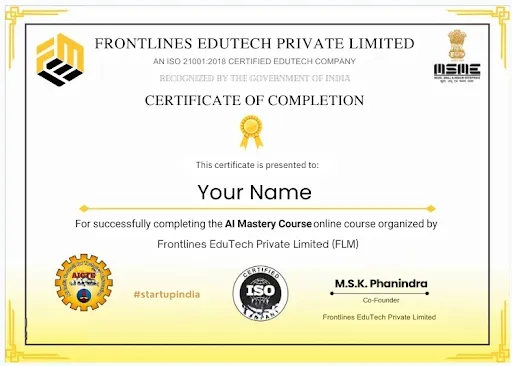
Q: Will I receive a certificate after completing the AI Mastery course?
A: Yes. Upon completing the training and deploying your real-time AI projects, you will receive an industry-recognized certificate from Frontlines EduTech to massively boost your LinkedIn profile and resume credibility.
Q: Do I need prior programming or AI knowledge?
A: No. The course syllabus states that no prior programming or AI knowledge is required.
Get Certified
Yes, you’ll get a Certificate representing your Industry Readiness once you submit your projects and clear the pre placement test.